Don’t Give Into the Deception: Reject Abortion and Stand for Life

A video circulated online earlier this week of a young woman speaking at a “Pick Up the Mic” event at the University of Texas, San Antonio. She approaches the man and instead of asking a question, she reads a poem gloating over the assassination of Charlie Kirk.

As disturbing as that was, there was another snippet in there that was equally disturbing, as she shamelessly tells the person at the booth that she took a Plan B pill that morning.

This wasn’t the stereotype of the blue-haired, left-wing lunatic going on an incoherent rant. This looked to be a normal, rather educated, and even attractive college student pridefully proclaiming that she ended the life of the child she had potentially just created.

It was a message: that this spiritual darkness has permeated deep into our culture, and it should be a five-alarm warning to those of us with ears to hear and eyes to see.

I can’t think of anything that has been more deceptive as the issue of abortion. There were even times in my life that although I claimed to be “pro-life,” I gave into the deception to an extent, either to keep the peace between those I was debating or for my own selfish reasons. Much of that changed, however, when I became a father. It wasn’t just the joy I received, but the love my children express in their everyday life. And when it comes down to it, they’re simply happy waking up every day and having the chance to live that life.

Now, Idaho, a state I hold near and dear to my heart having essentially grown up right next to it, and my home state of Virginia have ballots initiatives to legalize the practice. Just the language itself in the initiatives are purposefully ambiguous, meant to cause confusion to voters looking at it.

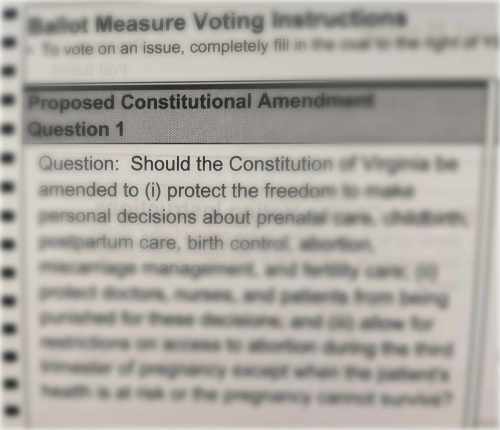
Here is how Virigina’s Proposition 1 is written on the ballot:

“Question: Should the Constitution of Virginia be amended to (i) protect the freedom to make personal decisions about prenatal care, childbirth, postpartum care, birth control, abortion, miscarriage management, and fertility care; (ii) protect doctors, nurses, and patients from being punished for these decisions; and (iii) allow for restrictions on access to abortion during the third trimester of pregnancy except when the patient’s health is at risk or the pregnancy cannot survive?”

While they at least throw in the “restriction on access to abortion during the third trimester” language, it gives a perception that this was drafted in moderation. But I find no moderation in ending the life at up to six months in the womb. And on purpose, it uses language such as “freedom” and “protection” as if these are virtuous things to mask the actual act of terminating a life.

As is the language of the first deceiver when he approaches Eve in the garden and says, “Did God really say, ‘You must not eat from any tree in the garden?’” (Gen 3:1). “My body, my choice,” doesn’t take into account the body inside the womb. Abortion clinics are called “Planned Parenthood,” though there seems to be nothing planned about terminating the life of an unborn child. “Restricting abortion access will put women at health risk,” completely ignores the fact that each abortion puts each child at nearly a 100% risk of losing their life. “Fetal Viability” is thrown around as if there is a day, hour, or minute that the baby suddenly has enough “value” or is deemed that it can survive outside of the womb, when it reality, it would take a child several years to be able to survive outside the womb without the nurturing care of an adult.

And maybe the most deceptive of all, “Safe, legal, and rare,” has turned into the young woman above who brags about the potential murder of her unborn child, for whenever the argument of “exceptions for rape and incest” come up (which many on the conservative side are willing to concede), rarely does it stop there, as the propositions demonstrate.

In the end, there’s no comfortable way of saying it, but abortion is murder. It is the intentional killing of an innocent life, and we should not lie to ourselves that it is anything other than that. For if we continue to allow this practice on a large scale, I fear that God will not spare us from His judgement, as he didn’t spare the Israelites—His “chosen” people—of judgement when they indulged in their own forms of spiritual darkness. Thus, if we don’t hold the line and reject this evil, I fear it will be our children and grandchildren who will be the ones who will likely suffer behalf than us who are responsible for it. And sadly, many unborn children already have suffered.

There is one last deception the devil will try to pull on us when it comes to abortion, one that Satan will use with any type of sin. He will make us feel irredeemable, that we are too far gone, and that there is no possible way we can make our way back into grace. In this, we easily harden our hearts, give into despair, and end up rejecting God and His order. But it doesn’t have to be this way.

For those who have ever had an abortion procedure, been involved in the industry, or convinced a significant other to get one, there is always a chance of repentance and redemption. I am a testament of this. Being a sinner that is unworthy of His love, I have received His forgiveness, and there is no sin so great that He can’t redeem. And while we must fight to hold the line against this evil, we can also show love by praying for those riddled with this guilt to seek forgiveness, accept the free gift of salvation, and turn their life over to Jesus.

Thus, I again urge those living in States where these propositions are on the ballot to reject them, and to take a stand for life. The soul of our nation, as well as our very own souls, may be on the line.

The Touch of Life – A Rugby Novel by Ike Andrews

There have been distinct moments in my life where I have been extraordinarily proud of my father. The first was in the 4th grade during a “what does your dad do for work” presentation where he turned a pedestrian career in the paper industry into an exciting exposition of international business, making me the envy of the classroom for having such a “cool” dad. The second was when he delivered the eulogy for his best friend Brian, honoring him and his Lord with his convicting message. And upon my re-reading of The Touch of Life, that feeling of pride swelled within me once again.

I was roughly five years younger than Professor Michael Burke the first time I read this book, an age where I was too occupied with partying and making skateboard videos to read a 500-page novel. Yet, despite my prodigal tendencies, remnants of God’s command to honor your parents still clung to me. So, I read on. And for a kid who found reading to be a chore up until that point in life, I genuinely enjoyed the read, much like a teenager’s first viewing of The Lord of the Rings trilogy. It was a surface-level enjoyment, where I laughed at the antics of Ripper, cringed at the weasel known as Jeff Sheonick, and was on the edge of my seat during its climactic finale.

And to this day, I can still remember the night I finished the book. I was glued to the final chapters, unable to sleep until I discovered the fate of the Select Side rugby players. This of course, became problematic, since I was slated to wake up at 5 AM for a full day of salmon fishing with my father and some friends from church. On paper, it’s an experience any man would be grateful for, but for a 21-year-old college student on Christmas break, I wasn’t exactly enthused for the outing, nor for the eight hours spent in the middle of the Snake River freezing my butt off.

I actually caught one during one of those trips!

Despite the dread of an early morning fishing trip, I put down the book that night satisfied that I had just read a well-written thriller that any connoisseur of fiction would be proud of. But even though I would go on to recommend it to others, I still lacked the maturity to understand the deeper themes presented. And similar to the Lord of the Rings, it would take half a lifetime to truly appreciated the emotional and spiritual depth of this book.

When my father approached me with the idea of re-releasing The Touch of Life (now that eBooks have made reading more accessible), I happily obliged. Feeling that I owed him a favor after he graciously proofread my own novel, I also knew it would be a good exercise for someone who had just started his own publishing company. What I didn’t expect is how much more I would enjoy reading it the second time.

Now, being the approximate age of my father during the time he wrote this, the story hits from an entirely different angle. It astonished me how well my father captured the zeitgeist of not just Wisconsin in the late 1970s, but of being a young man navigating the path into adulthood. From the very first chapter, I felt like I had been there, a stranger in a strange land, finding routine and contentment with the little you have. I could relate to the feels and struggles of the professor, and even found joy in the simple details of his surroundings, from the scent of freshly mowed grass to the peaceful ambience that encompasses a college campus after students have left for the summer. Though the settings may differ, it’s during these transition periods that lead us into wonder, longing for change, yet clinging to that last vestige of an adolescent spirit. It’s what led the professor to the sport of rugby, and strangely enough, it’s activities like rugby—molding the physicality of youth into the courage of manhood—that best propel us into the throws of the real world.

Fox River Rugby Club, where much of the book was inspired from, Circa 1980.

There’s brutal honesty portrayed in every facet of the story, a quality that’s often missing in modern writing, especially given the superficial culture promoted through social media. The foul-mouthed, beer-guzzling antics of rugby culture, though humorous at times, will make many wince. Graphically depicted are the carnal desires of sex, not for titillation, but as a reminder that the temptation is real in every man, and in a day and age where pornography is accessible at our fingertips, it’s a sin that is too-often ignored in fear of self-implication. “The Rape of the Planet” reminds us that there is unabashed evil in our world. Yet it’s evil that all good men must eventually confront, for evil has a way of metastasizing if left unabated.

And that’s the risk of honest writing. It exposes our own sins, insecurities, and weaknesses, and can give wicked men ammunition to tear you and others like you down. But, in doing so, there is also the potential for great reward. It shows the most depraved among us that there is salvation, no matter how much of a misfit they are on and off the field. That like them, we are severely flawed, but if we accept Jesus as our Lord and Savior, He has a way of destroying those demons and promoting the good within us; qualities like loyalty, determination, and most of all, courage that are developed on the rugby field.

And that’s what I find most admirable about this story; the courage my father displayed in writing it. In exposing his own vulnerabilities, he reminds us that like rugby, life can be quite muddy. It’s filled with messy situations, violent encounters, and requires decisions where morality is often muddled. And after a long-fought match, win or lose, we often come away better equipped to face the next, having persevered through the very end. And whether it’s between teammates, opponents, or even enemies on a battlefield, there is great honor that is shared amongst men in these environments.

I believe there’s a providential connection between the passage of time and the re-release of this book, for perhaps the greatest endorsement I can give is by the time I got to the last page, I had shed a tear. Like those characters in the epilogue, I’m wiser, married with kids, and have had time to reflect on the many trials of life. And despite the pain felt during many of those trials, the second reading truly made me grateful for those life experiences, and God willing, for a life that has several years left.

Nobody but my old man and the Lord will fully understand the amount of time, heart, and sacrifice that was put into writing this book. The unfortunate reality for most writers is that the fruits of their labor will never be fully realized. And having written a novel myself, I can sense his passion for this story, paying homage to the game of rugby and the teammates he met along the way. In doing so, he has brought honor, not just to them, but to his Lord and Savior, Jesus Christ.

If you are among the few who have stumbled across this gem, consider yourself blessed. You are in for an exciting adventure. You are about to dive into the rough and gruff world of rugby. You are about to see how the Holy Spirit can rebuild the most broken among us. And for that, I am honored to share this book with you.

Zachary Michael Andrews
Grizzly Chadams Publishing

The Touch of Life is available now on amazon.com. If this post spoke to you in anyway or if you know anybody who would enjoy a sports thriller based around rugby, please consider supporting us independent authors by purchasing a copy using the link below:

https://www.amazon.com/dp/B0H2PVQN5N